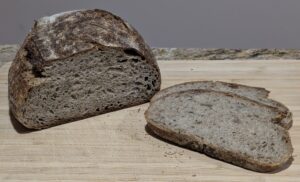
Rye bread has always been one of my favorite breads—deeply flavorful, hearty, and unmistakably satisfying. It is the kind of loaf that instantly elevates a meal, and for me it is absolutely essential whenever I prepare a batch of corned beef or pastrami. A thick slice of fresh rye, whether piled high into a sandwich or simply served warm with butter, has a character that few other breads can match.
This sourdough rye is a natural extension of my standard sourdough method, adapted to bring in the distinctive earthy complexity that rye flour offers. The dough combines the familiar slow fermentation and gentle tang of sourdough with the robust flavor of rye, while caraway seed and ground caraway add the unmistakable aroma and taste that define a classic rye loaf. The ground caraway disperses its flavor throughout the crumb, while the whole seeds provide those traditional bursts of spice in every slice.
The result is a bread with a slightly denser crumb than a typical country sourdough, a rich aroma during baking, and a crust that develops beautifully in the oven. It is sturdy enough for sandwiches, yet tender enough to enjoy on its own. Whether paired with deli meats, cheese, smoked fish, or simply toasted for breakfast, this loaf has the old-world character that makes rye bread so enduringly popular.
Like all sourdough breads, patience rewards the baker. The slower fermentation not only improves texture but also deepens flavor, giving this loaf a complexity that commercial rye breads often lack. It is a bread worth making not just for special meals, but whenever you want a loaf with real personality and depth.
- 650g bread flour
- 200g dark rye flour
- 20g salt
- 25g ground caraway
- 25g caraway seed
- 250g sourdough starter mix
- 500g bottled purified water
- In a large bowl, combine the room temperature water (70-75F) and sourdough starter, mixing until fully blended.
- Blend the bread flour, rye flour, salt, ground caraway and caraway seed in a separate bowl.
- Add the dry ingredient blend to the water/starter mixture and mix with a spoon until all of the dry flour is incorporated and a shaggy dough forms.
- Cover the bowl and let the dough rest for 2 hours.
- Using a wet hand, perform one set of stretch-and-folds: pull one side of the dough upward and fold it over itself, rotating the bowl 90 degrees after each fold, for a total of 4 folds.
- Cover and let rest for about 30 minutes minutes.
- Repeat the stretch-and-fold process 4 more times, allowing the dough to rest for about 30 minutes between each set.
- Cover and let the dough rest at room temperature for about 30 - 45 minutes (5.5 to 6 hours from initial mix).
- Divide the dough in half and perform a preliminary shaping, dusting lightly with flour as needed.
- Gently stretch each portion into a square or rectangle.
- Fold each side inward to one-third of the width, then roll into a ball, tucking the sides inward as you shape.
- Cover with a light cloth and let rest for 30 minutes.
- Shape each loaf into a tight ball, dust lightly with rice flour, and place into a well-floured(rice) proofing basket.
- Cover and proof at room temperature for about 8 hours.
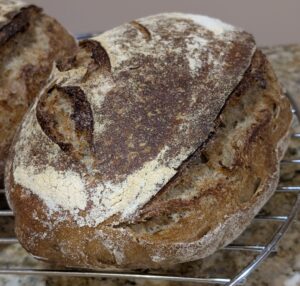
Preheat your oven to 450°F (230°C) with a covered Dutch oven inside so it fully heats along with the oven. Carefully turn the dough onto a sheet of parchment paper and score the surface as desired, making one deep full-length slash along one side to encourage proper oven spring. Using the parchment as a sling, transfer the dough into the hot Dutch oven, add 2-3 ice cubes for steam, cover immediately, and return it to the oven. Bake covered for 20 minutes, then remove the lid and continue baking for an additional 30 minutes, until the crust is deep golden brown and crisp. Remove the loaf from the Dutch oven and let it cool completely on a wire rack for at least 2 hours before slicing to allow the crumb to fully set.
- Enjoy with butter, toasted with butter, toasted with buy and marmalade, preserve, jam or jelly, apple butter or as a sandwich.