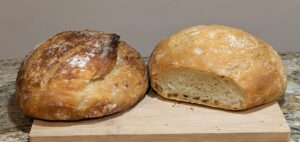
I’ve been making sourdough bread for about six months now, and over that time I’ve refined my process to make it as easy, consistent, and streamlined as possible. I started out maintaining four starter jars and baking a batch every other day, but I’ve since simplified the routine to baking every Monday and Thursday while keeping just two starter jars in the refrigerator.
The result is a reliable process that consistently produces excellent sourdough bread, whether I’m making a classic loaf, a rustic boule, or crisp, flavorful baguettes.
- 850g bread flour
- 20g salt
- 500g bottled water warmed to 100-110F
- 250g sourdough starter
I prepare my starter the night before I plan to make the bread. I keep two starter jars in the refrigerator and feed them weekly with 1/2 cup all-purpose flour and 1/3 cup purified bottled water. To prepare the starter for baking, I combine 100g of refrigerated starter with 1/3 cup water and 1/2 cup flour, which produces approximately 250g of active starter mixture. I leave this mixture at room temperature overnight. By morning, usually around 5:00 a.m., it is active, bubbly, and ready to use. The entire starter mixture is then used in the bread preparation described below.
- Weigh and thoroughly combine all dry ingredients (flour(s), salt, and any additional dry ingredients) in a large bowl.
- In a separate large mixing bowl, weigh and blend the wet ingredients (water and sourdough starter) until well combined.
- Gradually add the dry mixture to the wet ingredients, stirring with a sturdy spoon until all the flour is incorporated and no dry patches remain. The dough will be rough and shaggy at this stage.
- Cover the bowl with plastic wrap and allow the dough to rest at room temperature for 2 hours.
- With a slightly damp hand, grab one edge of the dough, gently stretch it upward, and fold it over toward the center. Rotate the bowl 90 degrees and repeat until you have completed four stretches and folds (one full rotation).
- Cover and rest for approximately 30 minutes, then repeat the stretch-and-fold process four more times, allowing a 30-minute rest between each set. You will complete five sets in total.
- Following the fifth and final set, cover the bowl with plastic wrap and allow the dough to rest undisturbed for approximately 90 minutes.
- Gently turn the dough onto a lightly floured work surface and divide it into two roughly equal portions.
- Working with one portion at a time, gently stretch the dough into a rectangle approximately 8" × 12", taking care not to press out all the trapped air.
- Fold the sides inward toward the center, then roll the dough into a rough ball.
- To build surface tension, gently pull the dough toward you across the work surface, rotate it slightly, and repeat several times until a smooth, tight ball forms.
- Place each shaped loaf seam-side up (smooth side down) into a banneton lightly dusted with rice flour. Gently pinch any open seams together to seal.
- Cover each banneton with a clean, dry kitchen towel and allow the dough to proof at room temperature for approximately 8 hours, or until properly risen and ready for baking.
- Preheat the oven to 450°F (230°C) with two covered 4.3-quart Dutch ovens inside.
- Turn each dough ball onto a separate sheet of parchment paper.
- Using a bread-scoring blade (lame), make one deep, lengthwise cut from top to bottom, approximately 1/3 inch from one side. On the wider side, make two shorter, shallower decorative cuts.
- Take the two covered Dutch ovens out of the oven and set them on the stovetop. Remove the lid from one Dutch oven.
- Carefully lift one batch by the parchment paper and lower it into the Dutch oven. Place three ice cubes between the parchment and the side of the Dutch oven, then cover. Repeat with the second batch.
- Bake covered for 25 minutes. Remove the lids, then bake uncovered for an additional 25 minutes.
Comments
Sourdough Process — No Comments
HTML tags allowed in your comment: <a href="" title=""> <abbr title=""> <acronym title=""> <b> <blockquote cite=""> <cite> <code> <del datetime=""> <em> <i> <q cite=""> <s> <strike> <strong>