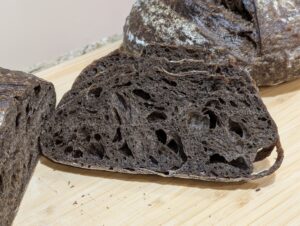
This recipe is a sourdough variation of my no-knead French pain noir, inspired by a loaf I first tasted on the island of Guadeloupe, a French territory in the Caribbean. That bread left a lasting impression—dark, aromatic, and deeply flavorful—rustic in the best sense of the word. This version is my tribute to that experience, adapted for the home baker.
True to my style, there’s no fancy equipment, no elaborate techniques, and no years of experience required. If you have a healthy sourdough starter and a willingness to try something a little different, you’re already halfway there. Beyond the usual flour, water, salt, and starter, this recipe layers in black cocoa powder, instant coffee, ground caraway, and whole caraway seeds. The result is a loaf that’s boldly dark, subtly bitter, slightly earthy, and wonderfully complex—without ever being heavy or intimidating.
Whether you’re new to sourdough or a seasoned baker looking to step off the well-worn path, this bread is meant to surprise and delight. It’s not a “safe” loaf—and that’s exactly the point. If you’re adventurous and curious about pushing sourdough in unexpected directions, this recipe is designed to thrill you from the first aroma to the final slice.
- 800g King Arthur bread flour
- 20g salt
- 15g black cocoa powder
[1] - 15g ground caraway
- 15g caraway seed
- 6g instant coffee
- 25g unsulfured blackstrap molasses
- 250g sourdough starter
- 500g bottled purified water
- Warm the water in the microwave to approximately 90–100°F.
- Combine the warm water, molasses, and sourdough starter. Stir until well blended.
- In a separate bowl, combine the bread flour, salt, black cocoa powder, ground caraway, caraway seeds, and instant coffee.
- Add the dry ingredients to the wet ingredients. Mix with a sturdy spoon until no dry flour remains and a shaggy dough forms.
- Cover the bowl and allow the dough to rest for 2 to 3 hours.
- Perform one set of stretch-and-folds by stretching and folding the dough four times, rotating the bowl 90 degrees after each fold. Cover and rest for 40 to 45 minutes.
- Repeat the stretch-and-fold process three more times, allowing the dough to rest for 40 to 45 minutes between each set.
- After the final set of stretch-and-folds, cover the dough and allow it to continue fermenting until a total of 6 to 7 hours has elapsed since the ingredients were initially mixed.
- Turn the dough out onto a lightly floured surface and divide it into two approximately equal portions.
- Gently stretch and flatten each portion into a square or rectangle.
- Fold one side of the dough one-third of the way toward the center. Fold the opposite side over it, then roll and tuck the dough inward to form a ball.
- Shape each portion into a tight ball. Place each loaf seam-side up in a well-floured proofing basket, pinching the seam closed if necessary.
- Dust lightly with flour, cover with a cloth, and proof for 6 to 7 hours, or until the dough is visibly puffy and slowly springs back when gently pressed.
For baking, I recommend using a cast-iron Dutch oven for the best results. I use two 4.3-quart cast-iron Dutch ovens, but you can also use one Dutch oven and bake the loaves one at a time.
- Preheat the oven to 430°F with the Dutch oven(s) and lid(s) inside. Allow the Dutch oven(s) to heat for 20 to 30 minutes after the oven reaches temperature.
- Gently turn each loaf out onto a sheet of parchment paper.
- Score each loaf with one deep, full-length cut along one side and two or three shorter, shallow decorative cuts along the other side.
- Carefully remove the hot Dutch oven(s) and lid(s) from the oven.
- Using the parchment paper as a sling, gently lower each loaf into a Dutch oven.
- Place two ice cubes between the parchment paper and the side of each Dutch oven. Immediately cover with the lid.
- Return the Dutch oven(s) to the oven and bake, covered, for 20 minutes.
- Remove the lid(s) and continue baking for approximately 25 minutes, or until the loaves are deeply browned and fully baked.
- Carefully remove each loaf from the Dutch oven and place it on a wire cooling rack.
- Allow the loaves to cool for at least one hour before slicing and at least two hours before placing them in storage bags.
- Black cocoa powder